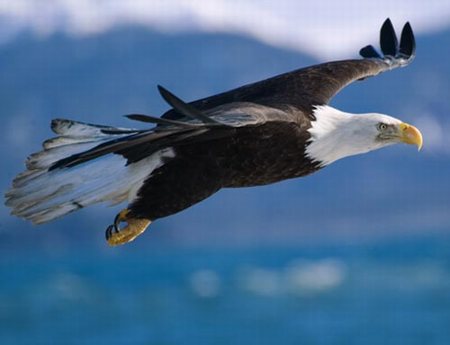
This year, the famous eagles’ nest east of Llano has lost one of its adult eagles. However, since there were three adults tending the nest for the past several years, life goes on for the others. A male and female adult pair already have laid eggs in the nest, which sits in a large native pecan tree right on the banks of the Llano River.
In fact, one of the eggs probably already has hatched, a Texas Parks and Wildlife Department biologist said, and the eagles are on their way to another successful nesting season. “The way the adults have been acting, with lots of activity and looking down into the nest, I think one of them has been hatched,” said TPWD wildlife biologist Dale Schmidt of Llano.
“I drive by there every day and there’s been a big difference in the activity in the nest.”
A Saturday trip to the nest, which is in its fifth year in the single location that hangs right out over the riverbed, found two eagles in the pecan tree. One sat inside the nest, head just barely showing most of the time, and the second adult kept watch a few yards away in the top of a second tree.
“The third adult didn’t show up this year,” Schmidt said. “We don’t know what happened, but that’s one of the things that happens to them. They’re out there hunting and flying and then they just don’t make it back.”
Three adults had been seen on the nest since it was built in the pecan tree in 2004.
“That’s been a real successful nest,” Schmidt said. “In that nest, they’ve fledged six eaglets since 2004.”
There were two young eagles that left the nest in 2004 and again in 2005, then a single successful chick each of the last two years. The youngsters leave the nest in late spring and move back northward in search of food. They follow the same migration routes as their adult parents and generally migrate southward to about the same area where they were hatched.
They will migrate back to Texas in the fall, and usually begin looking for mating partners when they reach sexual maturity at four to five years of age. By then, they’ve begun developing that distinctive white head and neck from which they derive their name.
Eagles spend a lot of time fishing, and the birds in Llano catch fish from the Llano River. They love softshell turtles, which make up a fair amount of the food they catch for themselves and the growing chicks. But the menu also can include squirrels and rabbits, rats, waterfowl and other birds.
The Llano River nest continues to grow, and the immense size is easily visible right now because there are no leaves growing on the pecan tree in which it sits. Unless they blow down or the tree dies and falls, the nests will be used year after year by the same pair of eagles.
They can live up to 30 years, so some of the nests reach tremendous sizes and weights. The current pair nesting along the Llano were in the area before they built this nest, but their old nest was blown down and they moved nearby to set up the current site little more than 100 yards off Texas 29.
Schmidt said he knows that eagles have been nesting nearby since 1989, though he doesn’t know if it’s the same pair.
“That’s a good nesting area,” he said, “but the (eagle) population around Llano has really been growing. It’s continued to grow all across Texas and the United States, which is why eagles were de-listed.”
Unchecked use of insecticides, as well as ignorant persecution, brought eagles within reach of extinction earlier in the 20th century. However, conservation and education efforts have restored the population to the point that the birds don’t have to be considered endangered. They remain protected, however.
In addition to the loss of one adult bird, the Llano nest has undergone another change in the last year, Schmidt said.
“This was the farthest western nest in Texas,” he said, “but it’s not anymore. Now we have one in the Panhandle that is active.”
There is parking on both sides of Texas 29 close to the nest, but visitors are encouraged to exercise caution leaving and entering the highway. Also, biologists urge eagles watchers never to cross the fence onto private property or to approach the nest, which could disturb the eagles.
We would like a current Feb. 2009 up-date on the Llano eagles.
What is going on ?? So we can pick a time to come see them again !
I saw them Monday – March 9th in the nest. But, you need binoculars and I didn’t have mine. It looked like 2 in the nest – both were active.
We want to make a trip up from Austin to view the chicks but need to know how much longer they will be in the nest? Could some one give us an idea of when they will leave the nest.
thanks,
bill
Bill, the eaglets are moving about now and leaving the nest, but they usually hang around in the mornings/evenings. I saw an adult bird twice (I drove by the nest on 3/16 and 3/18).
I stopped at the site today the 22 Mar 09 at about 2 pm and did not see the birds moving around. When I went by on Friday the 20th I did see them for a very short time.
Can anybody tell me what an eagle’s nest is called
Thanks
I love that we have bald eagles right here in Llano! I’m happy that they are off the Endangered Species list. I’m wondering if the construction of industrial sand plants in the area by Proppant Specialists, LLC will have a detrimental effect on the local eagles? The main particulate of concern is crystalline silica which is carcinogenic to animals (and birds) as well as humans.
The dust can blow up to 20 miles from the plant, not to mention the dust from transporting the sand and the diesel trucks that it is transported in. Proppant has applied to the Texas Commission on Environmental Quality for issuance of Air Quality Permit Number 97199 which would authorize construction of an industrial sand plant in Katemcy, Texas – right down the road; there’s already one in Voca and one in Brady, as I understand it.
How much crystalline silica and diesel fuel does it take to kill an eagle or drive them out of our area forever?
Is the Eagle nest still intact?. There was a rumor it fell and the eagles may have moved on. We would like to visit. We have a Nikon 7500 camera with a 600 lens. I hope that will be sufficient to see these beautiful creatures.
Thank you.
Philip LeStrange
We would like to see the eagle pair in December if the nest is still intact. Is the site still viable? We have a Nikon 7500 with a 600 lens I hope that will be enough to see these beautiful creatures.
Philip LeStrange
Philip, I believe they are still in the area but the nest is not in the same tree. I’ve heard reports of seeing them off the highway and/or flying over the river.