Grizzly (brown)Â bears are typical of all bears physiologically, behaviorally, and ecologically. They are slow growing and long-lived (20 to 25 years). Their ability to store and use fat for energy makes long denning periods (5 to 7 months) possible. During denning they enter a form of hibernation in which their respiration rate (approximately 1 per minute) and heart rate (as low as 10 beats per minute) are greatly reduced. Their body temperature remains just a few degrees below normal; they do not eat, drink, defecate, or urinate, and their dormancy is continuous for 3 to 7 months. The adaptive value of winter denning relates to survival during inclement weather, when reduced food availability, decreased mobility, and increased energy demands for thermoregulation occur. Continue reading Grizzly Bear Biology and Behavior
Month: May 2007
Grizzly Bear Food Habits
Food gathering is a top priority in the life of grizzly bears. They feed extensively on both vegetation and animal matter. Their claws and front leg muscles are remarkably well adapted to digging for roots, tubers, and corms. They may also dig to capture ground squirrels, marmots, and pocket gophers. Brown bears are strongly attracted to succulent forbs, sedges, and grasses. In spring and early summer they may ingest up to 90 pounds of this high-protein forage per day. Bears gain their fat reserves to endure the 5- to 7-month denning period by feeding on high-energy mast (berries, pine nuts) or salmon. The 2 1/2- to 3-month summer feeding period is particularly crucial for reaching maximum body frame and preparing for the breeding season and winter. Continue reading Grizzly Bear Food Habits
Shooting to Control a Deer Population
Effective use of the legal deer season is probably the best way to control deer populations. By permitting hunting, landowners provide public access to a public resource while at the same time reducing deer damage problems. Because of the daily and seasonal movements of deer, only rarely does a single landowner control all the land a deer uses. As a result, neighboring landowners should cooperate. Landowners, the state wildlife agency, and local hunters should reach a consensus about a desirable population level for an area before deer are removed. Continue reading Shooting to Control a Deer Population
Feral Hog Food Habits
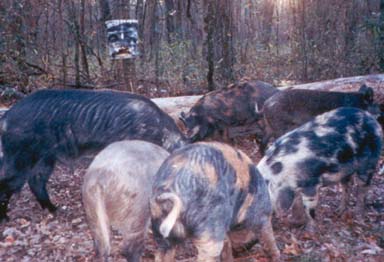
Feral hog food types vary greatly depending on the location and time of year. Wild pigs, however, will eat anything from grain to carrion (dead carcas). Hogs may feed on underground vegetation during periods of wet weather or in areas near streams and underground springs. Acorns or other mast, when available, make up a good portion of their diet. Continue reading Feral Hog Food Habits
Deer Repellents
Repellents for white-tailed deer are best suited for use in orchards, gardens, and on ornamental plants. High cost, limitations on use, and variable effectiveness make most repellents impractical on row crops, pastures, or other large areas. Success with repellents is measured in the reduction, not total elimination, of deer damage. Continue reading Deer Repellents
Trapping Coyotes
There are many effective methods for trapping coyotes, and success can be enhanced by considering several key points. Coyotes learn from past events that were unpleasant or frightening, and they often avoid such events in the future. In spring and summer, most coyotes limit their movements to a small area, but in late summer, fall, and winter they may roam over a larger area.
Coyotes follow regular paths and crossways, and they prefer high hills or knolls from which they can view the terrain. They establish regular scent posts along their paths, and they depend on their ears, nose, and eyes to sense danger. Continue reading Trapping Coyotes
Legal Status of Badgers
In some states, badgers are classified as furbearers and protected by regulated trapping seasons, while in other states they receive no legal protection. Contact your state wildlife agency before conducting lethal control of badgers.